
John 6:1-21. A study of applications.
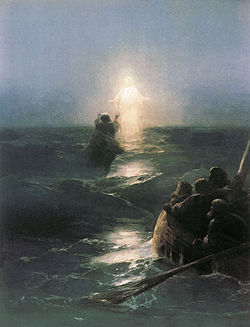
Jesus walks on water, by Ivan Aivazovsky(1888)
- Introduction.
- John 6 has four sections. We will look at the first two.
i. The Feeding of the 5,000
ii. Walking on the Water
iii. The Bread of Life discourse
iv. The Departure of many disciples after Jesus’ hard teaching
- The accounts in John 6 differ from the accounts in the Synoptics in their focus seems to be both on the disciples and the reaction/ interaction they have with Jesus, while largely the focus in John is on what Christ says and does.
i. The most obvious example is the inclusion of Peter’s request to walk on water that is covered (see Matthew 14:22-33, Mark 6:45-52, Luke doesn’t include the account, either).
ii. John includes some information that the Synoptics did not include, and he leaves out some points of information that the Synoptics seemed interested in and focused on apart from what John was interested in especially, the Person and work of Christ.
- The Feeding of the 5,000
- The crowd was probably much larger than 5,000 because the women and children were not counted. It was custom to count the men, it was a convenience and simpler way of estimating the crowd size. The food miracle is defined as dealing with 5,000 men. The implication is clear that there were many more people there.
- The test of Philip (6:5–6).
i. The account begins with the affirmation that “[Jesus] himself knew what he was going to do,” (see John 6:6).
ii. The disciples appear to be stumped by the difficulties of feeding so many people
- The crisis was Jesus’ making. He led the crowd out to the region where there was no quick and accessible food supply, there was no easy relieve of the hungry people other than to send them home.
- One can sympathize with the disciples because this was not a common problem that they have dealt with before. It has the trappings of a catastrophe.
- The solution was to take the barley loaves and fishes from a small boy. Stealing from a child appeared to be the most promising solution.
- Applications
- The disciples are stumped, we are often stumped, too.
- Their answers to solve the difficulty appear to be small-minded, almost panicked.
i. Their solutions did not take into account the capabilities of Jesus, though they had seen other miracles, amazing miracles at his hand. They didn’t seem to be able to apply what they had witnessed to the current situation. This is a common failing of the disciples.
- The test came at the direction and leadership of Christ. The people were there for a purpose. They need was one that Christ created. They difficult was his design. He did this for a greater display of his glory. To build up the faith of the disciples, and to provide for the need of the people.
i. Jesus knew what he would do. He knew what he was doing. There is never a time with the Savior doesn’t know, understand, or think about what he is doing.
- Sin often strikes us when we do not reflect, think about, search the will of God in a trial or difficulty we are facing. Christ sought the will of his Father and he led the people to this deserted place so that the disciples could be tested and that his glory could be displayed.
- There is never a time when Christ does not know what he is doing. Nothing surprised him. Nothing is too great for his mighty power. Nothing overwhelms him. Nothing can defeat him, unless it is the Father’s will. Nothing.
- Practical: Trust his competency completely. He is worthy of all your trust.
ii. The boy had barley loaves.
- This reminds us of 2 Kings 4:42-44 where Elijah is given 20 barley loaves to feed 100 men. The loaves were far too few to feed them all, but they proved to be sufficient and the miracle of Elijah was that all were fed aplenty.
- It seems clear that Jesus knew the story. A word from the LXX (Septuagint) from 2 Kings, describing the barley loaves, is the same word (a rather rare word, paidarion) that John uses. The other Gospels used another word (loaf) rather than the more specific and rarer term used in John 6.
- Seeing what Jesus did in feeding this great crowd ought to fill our prayers and petitions with hope and confidence about the One to whom we are praying. We must not complain about the great numbers, or the opposition, or the insoluble problems. God is capable of answering and of doing all he must and can.
- We must learn to pray for what only God can do and will do in the crisis of the moment.
iii. The abundance of the miracle was in the 12 basket-fulls they had left over.
- From the Didache 9:4, “As this broken bread was scattered upon the mountains and being gathered together became one, so may Thy Church be gathered together for from the ends of the earth into Thy Kingdom.” Noting that this is application (implications), not exegesis (meaning, context, and history).
- C.H. Dodd, “the pieces which are to be collected symbolize the bread which ‘abides’ and is not ‘lost’.” None is lost.
- The people responded by wanted to make Jesus the king.
- Jesus refused. He did not want to be an earthy king, his office and title was much greater than that of a human king.
- He was God in Human Flesh and Blood, the King of Kings, the Lord of Lords. It would have been the most grave of injustices to have merely placed him as the king of Israel, even king of Rome, yet alone as king of the world. He deserves more honor, infinite honor and glory is his, not early regal splendor, the splendor of heaven and Highest Heaven.
- He removed himself from that place and now acted to create an event that would show more of his glory. Walking of water was another of the signs, showing the disciples who he is (verse 19 shifts to the present tense, implying not only the imminence of the event in the apostle John’s mind, but the current capability of Christ, even at the time of writing, and in our day in the time of reading..
i. He must have given instructions to the disciples to cross over the Sea of Galilee and to meet him on the other side. They immediately departed from the Eastern shore of the Sea of Galilee
- The Sea of Galilee was about 7 miles across. They were crossing East to West. When they reached the half-way mark (3 to 4 miles, “20 or 30 furlongs”). Jesus came up them walking on the water.
ii. Walking on water was not a solution to a crisis. It was not necessitated by the illness of a person. He wasn’t walking on the water to facilitate a resurrection. It appears that he enjoyed walking on the water and that he desired to show his disciples more of his distinctions, more of the ways in which he was different from the disciples in his capabilities and works.
iii. Turns out that the destination of the disciples was Jesus walking in the middle of the Sea of Galilee and not the far shore.
iv. The account of Peter’s attempt to join Jesus is not included. Neither is the failure of the disciples to apply the “lesson of the loaves” in this situation. Their unbelief was not the focus, as it is in the Marcan account (Mark 6:45–51).
v. The account ends with the enigmatic account of the boat being transported to the shore, “immediately the boat came to the land.” Cryptic language that conveys perhaps how much those who were in the boat understood. He didn’t explain how it occurred, simply that it did. The record of an eye-witness. And the implications are for the reader to make.
- Lessons from the miracle of Jesus Walking on the Water
i. To see Jesus’ towering supremacy over all of creation.
ii. To understand how different he is from the disciples. Still a man, but much, much more.
iii. His leadership and foreknowledge. His perception of what the disciples needed to know and his ability to create experiences in which to teach, instruct, show, demonstrate, and reinforce lessons previously taught.
iv. The matter of the “will of the Father” comes up through John. Here again, the will of the Father is direct or implied, 6:37, 40, 44, 45, 47. It seems to be absolutely essential to Jesus’ decisions (what do I do?), choices (what is best in this situation?), and personal obedience (how shall I live?), and his direction (which way to go?), and ultimate destiny (what is my purpose?).
v. Practical: Christ creates situations in which we may not have a need, a sickness, or a crisis, but we need to know more of him. He directs us into an impossible situation, and there we must go because we know he is leading. But it seems to go nowhere. Do we trust him? Do we look for him? Do we believe that he is not limited by any measure, power, force, or spirit, to do what the Father wants him to do? And that he can be trusted completely even in the midst of the Sea, when we are not making headway, and our destination seems impossible.
- Jesus demonstrates in his signs his identity as the Son of God. No one can do the things that he is capable of. Nothing is impossible for him.
- Again, his distinction from other humans.
- Again, his mastery over all creation.
- His independency and his quest for joy in exercising his prerogatives as God/Man, walking on the water just for the fun of it; a delight to give the disciples a million questions to ask him.
- The transport of the boat to the other shore seems to be an inclusion of his friends in his miraculous power and for them to experience the miraculous for themselves.
- The purpose was to bring worship and glory to the Son of God by displaying his God-nature to his followers. To cause worship, not fear.
- Implication is that we out to pray to God who is capable, strong, able, wise, the ruler over all things and every circumstance. We ought to remember Jesus walking majestically, joyfully, on the water when we pray, to know who it is we are addressing: The Master of All Creation! God in Human Flesh. Who can do all things, and anything he wills to do.
- In sum: “No other man is like you.”
 Glorious Savior Church